Custom AI Automation
The work your team shouldn't be doing.
Quoting, intake, reporting, follow-up. The tasks that cost you a hire every time you grow, replaced in weeks with software you own.
Instant quote, running today
Three days to under a minute, while the buyer still cares.
It captures what the job actually needs, applies your real pricing logic including the exceptions someone keeps in their head, and sends the quote the same hour. Complex jobs still route to a person. The simple ones stop waiting on one, which is where the revenue was leaking.
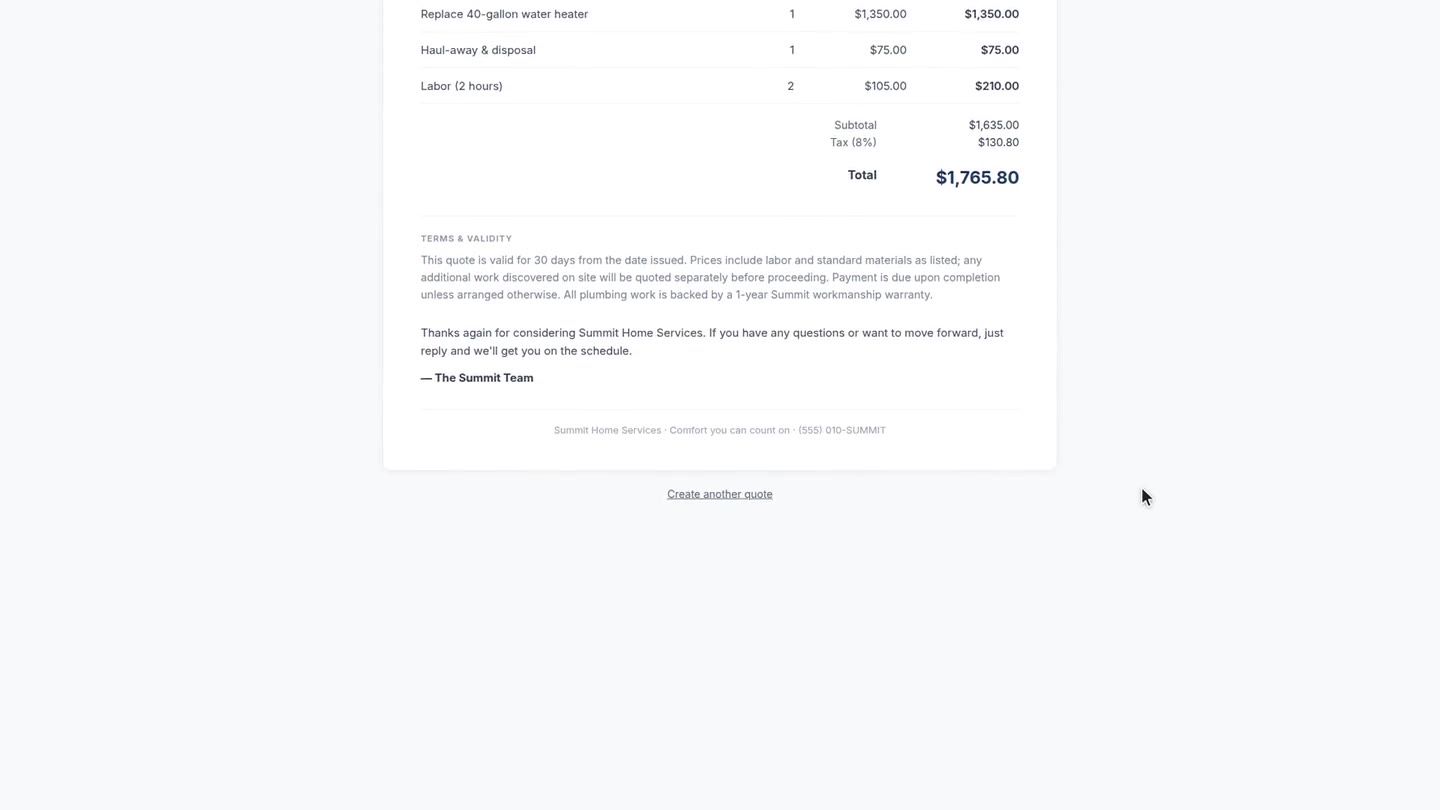
Six seconds from the running build, uncut apart from one join. See all three examples, with the demos →
01
Fixed price, agreed up front
02
Working prototype before the balance is due
03
Your own isolated instance, never shared
04
You own the code
The problem
Every team has three or four of these.
Pick the one that's yours and I'll work out what it's costing you a year, in your numbers. Four boxes you already know the answers to, and nothing is sent anywhere. Most teams have never done that arithmetic on the process that annoys them most.
It isn't a strategy problem, it's a tooling problem. Off-the-shelf software doesn't fix it, because the software doesn't know how your company actually works.
The process
Three steps. No procurement circus.
Scoping call
Free, twenty minutes. We work out what it's costing you now.
Working prototype
$3,500, three weeks, running on your own data.
Build and hand off
Four to eight weeks. Your instance, your code, thirty days of support.
Then the constraint moves. Fix the quote that waits on one person and scheduling becomes the problem. We keep watching the number, so you hear it from a review rather than from a bad month. Because you own the code, what you do next doesn't have to be me.
Where to start
Two ways in, both $3,500.
A free twenty-minute call comes first either way. Then one of these, and neither one commits you to a build.
You can name the bottleneck
Working prototype
$3,500
Three weeks, running on your own documents. Credited in full toward the build. If it isn't useful you stop there.
You can't name it yet
The half day
$3,500 remote
$4,500 on site. You leave with a written capacity map: every bottleneck your team names, what each costs now, what it costs at 30% more volume, and which to build, buy, or leave alone.
After that
The build gets priced at the prototype readout, against what we measured and what you can approve. Not hourly, not off a rate card, and not before either of us knows what it takes.
Once it's live, running it starts at $600 a month. That's hosting on your own instance plus monitoring, backups, and keeping it current as your documents and the models change, so nobody at your end has to own it. It's quoted at the same readout as the build, so you see both numbers together. All prices plus tax where applicable.
Questions
The things people ask on the call.
Do you host our data?
We run it. You own it. Those are different things, and the agreement keeps them separate. Your data is yours from day one, not on final payment. You decide what goes in and how long it stays, we act on your instructions and nothing else, and you can export all of it at any time without asking. Your instance and your database are yours alone, never shared with another client. What we provide is the operating: monitoring, backups, updates and re-indexing, so you don't need an IT department to run it. That is what the monthly buys.
What if we want to run it ourselves?
Then you do, and it isn't a negotiation. Your application lives in a GitHub repository, a database project and a hosting account. All three have a native ownership transfer, so moving them to you is an afternoon, not a migration, and the runbook comes with them. If you'd rather not wait for that day, we can put all three in your name at the start and operate them with access you can revoke. Say so on the scoping call. Some clients want it, most don't, and both are fine.
What if our documents are scanned paper?
They need to be digital text before they can be indexed. If your files are scans or photographs of pages, converting them is work your team or a document service handles first, and it isn't included here. Worth knowing: a PDF can be either. A file someone typed and saved is ready to go; a file someone scanned is a picture of a page, and it looks identical in your folder. The prototype tells us which you actually have.
What if the prototype isn't useful?
You stop. That's the point of doing it first. You've spent $3,500 to find out in three weeks instead of finding out in month five.
Do we own what you build?
Yes. At handoff you get the repository, your database, and a written runbook. Everything runs on standard, replaceable infrastructure with no proprietary lock-in, so any competent developer can pick it up. That's in the agreement, not a favor.
Whose account pays for the AI usage?
Yours, on your own account with the model provider. I set it up with you before launch, including the settings that keep your content out of training, and I show you what I configured. Two reasons it works this way. Your content is processed under your contract with them rather than mine, which is the answer your IT team wants. And you see what it actually costs, at cost, with nothing added by me. The prototype and the build run on my account, included in the price, so you don't need to set anything up to get started.
What if something happens to you?
Fair question for a one-person company, which is why the exit is engineered rather than promised. Your repo, your database project and your hosting account each have a native ownership transfer, and any competent developer can pick up standard React and standard Postgres. Nothing here runs on anything proprietary to me.
How is this fast if it's custom?
AI-assisted development genuinely compresses the build. It doesn't compress the thinking, which is where most projects actually fail. You're paying for the second part.
What happens after handoff?
Thirty days of support are included. After that you can take it in-house, keep a monthly arrangement, or hand it to whoever manages your systems. All three are normal.
Are you insured?
Yes. Technology errors and omissions coverage, certificate available on request.
Who is this not for?
Companies wanting a consumer app, a full platform rebuild, or something with a twelve-month roadmap. Also anyone whose security policy requires software to run inside their own cloud or on their own servers. I run these on managed hosting, and if in-tenant deployment is a hard requirement, I'm not the right fit and I'll tell you on the first call.
What's the smallest thing worth building?
Roughly: if this process would need another person the next time volume climbs 20 to 30%, it's worth a conversation. If it's just annoying and it isn't growing, an off-the-shelf tool is probably the right answer and I'll point you at one.
Start with the bottleneck, not the technology.
Twenty minutes, no deck, no discovery process. Describe what's slow, and we'll work out together what it's costing you. If it isn't worth building, that's a useful answer too.
Built by one person who spent thirty years inside operations, not an agency. Who I am →
What happens on the call
You describe the bottleneck in your own words.
I ask what one cycle costs, how often it runs, and what it looks like at 30% more volume.
We put a number on it together, and you tell me whether it's right.
I tell you whether that number is worth a $3,500 prototype, or whether an off-the-shelf tool already covers it.
No deck, no discovery process, no follow-up sequence.